Wednesday, October 12, 2011

Wearing the "C"

The Desperados hockey club in Santa Rosa in 2008.  In this photo, I'm actually wearing the "A" for alternate captain in the center of the first row.

My lovely Louisianian wife, oddly enough, was the first Captain of an ice hockey team in our house.  Being the team captain in any level of ice hockey is a position and honor unmatched in any other team sport.  Some great hockey captains, like Mark Messier, can be forceful and vocal leaders on and off the ice.  Others, like Steve Yzerman, are quieter and just lead by example.  Most hockey captains are usually among the best players on the team at the higher levels, but even in the NHL you may find some captains who are just grind it out "lunch pail" types of guys who give you their best effort every night.

At every level of hockey, each team is permitted to have one captain wearing the "C" on their sweater and up to two alternate captains who wear the  "A's".  They are supposed to be the only players on the ice to speak with the officials during a game.  They are expected by the coaching staff, and their teammates, to be leaders on and off the ice. 

Each season there are a couple of NHL teams without a captain that designate three players to wear "A's" and share the leadership responsibility.  Teams without a captain are usually younger and lacking veteran leadership.  I would argue they also have an idiot for a General Manager (I'm talking to you Colorado and Florida) because you shouldn't ever have an NHL team without a player who isn't capable of being the Captain.

Charles Schulz - the longtime Peanuts cartoonist - owned the ice rink in Santa Rosa and decided in the late 1990's that there should be more women playing hockey in his rink in Santa Rosa.  He recruited a couple of coaches, donated one of his coveted weekly mid-evening ice slots to the women and, for the first time, hired a security guard to patrol the rink's parking lot, so the women would feel safe coming and going from their car to the rink.

Word went out that women of all ages were encouraged to come to these weekly clinics.  After a few months, they built up a core of about 20 hockey playing women and formed a team, the Storm, in the lowest level - "C" league - late night adult league. 

The Storm played a couple of seasons in the lower level adult league and some of the women - especially the younger, athletic ones - took to the game so much and improved so rapidly that they left the women's team - the Storm - and moved up to other teams in the faster, higher skilled "B" league.

Eventually most of the women dispersed among the teams in the adult leagues with a core few remaining with the original Storm.  As the original women of the Storm moved to different teams, my wife was soon chosen as the Captain of the Storm.  She was friendly, had been on the women's team from the beginning and was the only female USA Hockey certified coach at the rink (she helped teach the beginner "Basics" class to youngsters on Saturday mornings).

I helped her out behind the scenes in compiling her roster and making sure everyone had their paperwork filled out correctly and made their payments on time.  She had to order new sweaters, numbers and front logo patches for any new players joining the team.  Before each game she had to make up her lines - groups of three forwards and pairs of defensemen - who would play together during the game.  She would be the designated person to speak with the officials should the need arise during the game.  Even though she was never their best player, she was their leader.

As I helped out as an assistant coach on a couple of my boys' hockey teams, I was witness to the leadership dynamic at an early age.  How it worked and sometimes how it didn't work.  I was also present each time we counted the votes for captains on each team.  The captains were usually voted nearly unanimously and the two assistant captains usually stood above anyone else as well.  And I don't ever recall a team voting themselves inappropriate captains.  It was something they took seriously and did quickly without much thought or reflection.  Everyone knew who their leaders were.

I was assigned to a team when I first joined the adult league in Santa Rosa and stuck around on that same team for years and years.  The roster would always have several changes from season to season - some guys would move up to the "B" league while some would take a season off and come back later - but the basic core group of guys remained from year to year.  Eventually a couple of captains moved on and it was my turn to be the Captain of my team. 

I was an obvious choice at that point.  I had been around for years and was well-known among my teammates and at the rink, I was the only USA Hockey certified coach on my team and I was reasonably organized and responsible.  I asked the guys if anyone objected or if they wanted to take a vote, and everyone just shrugged their shoulders and said, "Sure, yeah, whatever."

I started typing out spreadsheets of the roster with ages, addresses, contact numbers, etc.  I sent out e-mails to make sure I knew who was returning for the next season and tried to recruit new players to fill in open positions.  I ensured everyone had made their hockey payments to the rink.

Prior to every game I would go through my available line-up and determine lines and defense pairings for that night's game.  I begged everyone to call or e-mail me before the game if they weren't going to be there, so I knew what I had to work with, but there were always a couple of guys who wouldn't show up and wouldn't let me know. 

I had a small magnetic board with a series of small 1" magnets with every players name on our team.  I would arrange the names as they would play during the game.  The first forward line to start the game would be the first three magnets at the top.  The left wing would be on the left side, center in the middle and right wing on the right, etc.  Just below the three lines (hopefully) of forwards would be the two or three pairs of defensemen (less people would show up for the later games which started at 10:30 at night) placed in the order they would go out on the ice and which side - left or right - they would play during the game.

I would come to the rink with an idea of my lines and pairs made out and then make a few small adjustments during the warm-up as I sized up who was and wasn't in attendance that evening.  Some players would request a position or linemate before the game, and I always tried to accommodate any reasonable request.  I would call everyone together after the warm-up and announce the lines.  I would then place the magnetic board in front of the forwards, up against the boards of the rink, so they could look down and see where they were supposed to be during the game.

The board thing was pretty anal - most captains just wrote their lineups on a piece of paper and crossed out anyone who hadn't shown up that night - but I found it really easy to adjust and use.  I received a lot of ribbing about it from the guys, but one night I forgot to bring it and told them to just do what they normally do and complete panic ensued.  I believe we received a couple of "too many men on the ice" penalties because of the confusion as well.   Next week, I brought back the lineup board.

Many nights there really was very little difference between the kids and the adults.  Even though I'm not a skilled hockey player or veteran coach, I had enough hockey knowledge to point some things out to the beginner players to help them improve their game. 

I would beg and plead for everyone to take shorter, more intense shifts (a good hockey shift is about a minute - shorter in a higher level game), instruct them on the various ways to cheat on a face-off and give them tips for positioning.

No adult hockey league teams have practices as a part of the league - although I would usually schedule 4 or 5 each summer and bring in various coaches to help us out - so you had to instruct players on the fly. 

One night I noticed a newer player who was really energetic and always around the net getting frustrated because he couldn't buy a goal.  He was always so close to the net that when a rebound came out it went by him so quickly that he couldn't even react.  Plus, he was so close to the goalie that he didn't have too much of an angle to get a puck by the goalie.  I suggested he back out a bit - stop five feet from the goalie instead of right on top of him and that would give him more time to react and shoot.  He tried it and scored a couple of shifts later. 

As a Captain, I never yelled at a referee during a game.  I knew most of our adult league refs off the ice and didn't want to give them a hard time, but I just felt it was counter-productive.  They weren't going to change a call they had just made and you didn't want to tick them off for the rest of the game.  My tact was more to stand next to a ref just before a face-off and quietly say to him, "Might have missed that last call," if I thought they were wrong.  Occasionally they would admit they didn't have a great view or that the other ref who made the call might have blown it.  It's all part of the game.  We would often get a "make-up" call to even things out a few minutes later.  That's hockey.

I prided myself on not taking penalties - I had seen in my years around hockey that good players usually didn't take many penalties - and could get worked up if guys took stupid penalties in close games.  But when I sensed the moment was right, I would occasionally take a dumb penalty to fire the guys up.

One night we were slow and lifeless and went down 3-0 early in the game.  An opposing player shot the puck on our goalie and skated right towards him as the goalie froze the puck.  He sprayed the goalie with ice as he stopped - a common intimidation trick in hockey.  Sensing we needed a change in momentum, I immediately rushed over and just ran right through the guy - knowing I would get a penalty.  What I didn't expect is that the ref called the other player for the spray as well, meaning it didn't cost my team anything.

As I took a rare trip to the penalty box - which was right next to our team's bench - I could hear the guys on my team yelling and getting all fired up because I had played a little feisty and gone after someone trying to run our goalie.  From that moment on, the game completely changed.  Our whole team played with a little more jump and toughness.  We scored a couple of shifts later, tied the score by the middle of the game and went on to win 5-3.  My little penalty was the turning point of the game.  It got the boys fired up.  I never could have hoped for such an instantaneous and potent reaction, but I knew we needed something.

My oldest son, center, holding the championship banner after winning the California 16A State Championship last April.  He was the team's Captain.
My oldest son has been the Captain of his hockey teams the past two seasons here in San Jose.  In past seasons, he has often been an alternate captain, but never worn the "C."  He wasn't the most highly skilled player on either team, but he was friendly, inclusive, smart and tough.  He seemed to get along with everyone and tried his best to keep them together.  Both teams had terrific chemistry on and off the ice and they won the state championship in their 16A bracket last year.  You know everyone is pulling in the same direction when you have a winning team like that. 

I will never forget him telling me a story about their pregame warm-up early in the year his first season as Captain.  The captains in youth hockey usually lead the boys through their off ice pregame warm-up to get them ready for the game.  Boys being boys, many of them resist doing anything too strenuous they don't see as necessary.  The team typically goes out for a little half mile run to get their blood pumping and warm them up.  Every youth team does this at every level, especially in California, and just finds a place to run inside if the weather is inclement outside.

So my son's team is standing outside an opponent's rink after an hour drive from San Jose, ready to start their warm-up run, and one of the kids tells my son he's kind of tired and how about if they don't run all the way around the rink today.  My son - the Captain - thinks on it for a moment and suggests instead of running ALL the way around the rink they just run halfway around - and then come back.  Everyone else ponders that for a moment and agrees that's a good compromise and is happy.  They then proceed to run halfway around the rink and then turn around and come back the same way.  I laughed when I first heard my son tell me that story and I smile every time I think about it. 

And that's what makes a good Captain.

Tuesday, October 11, 2011

The Blooper Pitcher

One of the baseball diamonds at the Rincon Valley Little League in Santa Rosa, CA.
My two boys played in the Rincon Valley Little League in Santa Rosa for five seasons.  They were both on the same teams until their final two seasons when my older, larger son was drafted "up" to the "Majors" division.

This was the division where the managers were all under the delusion they were Joe Torre or Tony LaRussa, the games were played with an intensity and seriousness that would have put a Major League World Series game to shame and where if you weren't one of the top guns, you would only play your minimum required number of innings in the field and get your minimum number of at bats; even if the game was a 12-2 blow-out.

The entire culture and ethic of this league - where he played on one of the top teams - was enough to drive my oldest son out of baseball after two years of this crap.  I couldn't blame him.  He was twelve years old.  Another Life lesson learned.

My younger, smaller son, however, would wind up playing on a motley team of baseball misfits in the "Minors" division, lovingly drafted by a man who was a baseball fanatic.  Unfortunately, if you're only goal was winning, he cared more about everyone having a good experience playing baseball and getting a chance to play each position and have different people as teammates (he always seemed to draft any girls available and both years we actually were the only team with two girls on the roster - both good players).  All and all, I think it was more fun to play and coach in this lower "Minors" league.

Somehow this Manager recruited me as one of his assistant coaches.  I never played the game at a high level or coached baseball at any level.  I figured my job was to show up and coach first base and let the kids know when to run, slide and stop.  Pretty simple.

Our team seemed to get pounded each season.  Opposing teams would rack up incredibly lopsided games against us.  And if a game was close in the late innings, they would start to panic and bring in their top pitchers to shut us down.  There wasn't a worse fate to opposing teams in the Minors than losing to our team - the Indians.

But somehow, with the baseball gods taking pity on us, miraculously, we managed to squeak out a win or two each season.

My youngest son was a huge part of one memorable victory the second season.  Somehow, and I'm not quite sure how this happened, he developed a "blooper" pitch with the coaching and encouragement of his Manager.  I don't recall if he saw my son throw it a couple of times in a game or practice or if he taught it to him.

My son could throw a slow, high arc pitch that was almost like a high lob pitch in a Sunday afternoon softball game.  It was a "blooper" pitch.  The trick was that he could throw it for strikes.  Some of the umpires wouldn't call it properly because it started off so high, but most of them would call it as a strike if it came over the plate between the batters' knees and chest - which it usually did.

The first time my son faced a new opposing team from the pitcher's mound, the opposing batters didn't seem to know what to think of it.  They were inclined to just let it go by.  And if the umpire was paying attention and called it a strike, well, then they kicked their cleats down in the dirt and tried to take a closer look at this thing.  But it was deceptively tough to hit.

But here's where things got interesting.  You see, not only could my son throw this high, slow "blooper" pitch all day long - his motion was so relaxed when he threw it that there wasn't any stress on his arm  - but he actually had a regular pitch, his version of a fastball, that he could usually throw right down the plate for a strike.  It wouldn't have appeared fast compared to other pitchers or been effective by itself, but it really threw batters off after watching two or three of the "blooper" pitches going by.

Our Manager called the pitches from the dug-out and had an excellent sense of which pitch to throw to keep the batters off stride.  After each pitch, my son would walk towards the catcher and retrieve the ball, take a look into the dug-out on his way back to the mound and get the signal for the next pitch from the Manager.  He would usually nod and sometimes he would crack a sly smile.  I think the Manager took his hat off if he wanted the "blooper" pitch.  It was pretty simple.

So the misfit Indians were nearing the end of the season with nary a win.  My son started one of the final games of the season on the mound and was throwing his "blooper" pitch and his fastball quite well.  The umpire was calling the blooper pitches strikes if they went through the strike zone.

The first time through the order, my son kept the batters off balance enough that most of them struck out or grounded out weakly to an infielder.  This was Little League, so there were always errors and miscues on the simplest of plays, but we were doing pretty well after two innings.

Now he had to get through the order a second time and the opposing players had seen a lot of this pitch.  They had slowed down every reaction and motion in their body to hit this pitch.  If you were ready for it and patient, you could hit this pitch over the fence, but that was a rare occurrence.  It was a huge adjustment for a 10 or 11 year old to make.

My son made it through the third inning - the games were six innings - and we were leading at the halfway mark in the game.  We had an excellent, hard-throwing relief pitcher - the Manager's son - if my son could just get through one more inning.

You could sense the opposing team's players - and most prominently their parents - starting to get a little restless as the game moved along with the lowly Indians in the lead.  My son was starting to tire a bit and struggling with his control.  We really needed him to get through this inning.

There was supposed to be a pitch count in Little League, but we never even kept track when my son was pitching because he didn't throw that hard and there wasn't any stress on his arm.  He just mixed speeds and threw strikes.  And this was his final outing of the season.

The Manager called "time" and asked if I would like to go out to the mound and check on how my son was feeling.  As I walked out to the mound, some panicked overzealous Mom on the other team yelled at me that he was already over the pitch count.  Really?  It's the second to last game of the season and you're keeping track of the pitch count for the opposing team?  I just glared at her and yelled, "Lady, gimme a break!"

I walked up to the mound and asked my son how he was feeling and if he thought he could get through this inning.  I told him not to worry if they hit the ball.  Just change speeds and throw strikes.  Let the fielders do their work.  He nodded and I walked back to the dug-out.

You could read my son's determination on his face as the next batter stepped into the batter's box.  He crouched down low and looked intently at the catcher, his pitching arm swaying limply by his side, just like he was a Big League pitcher.

He threw a couple of "bloopers" for strikes and then threw his fastball towards the plate.  The batter hit the ball, but not hard because he was off balance after the two previous "blooper" pitches and grounded out to second base.  My son smiled as he returned to the mound.

"Blooper," fastball, "blooper" and another batter grounded weakly out.  He just needed one more batter.

The next batter was able to foul off a couple of his "bloopers" and it was obvious my son was getting tired, but he hung in there.  He threw a fastball just off the plate and then reared back slowly with one last "blooper."  It seemed to hang in the air forever - tantalizing any batter who could wait on it long enough to hit it cleanly - and the batter swung in an awkward arc and missed.  Strike three.  My son had made it through four innings and kept the lead.

The Manager now put his son out on the mound.  His son was quite small, but a skilled and talented baseball player (he now plays high school ball).  If he was on his game, he threw the ball hard from the mound.

The first batter walked to the plate, undoubtedly relieved he didn't have to face that stupid "blooper" pitch any more, and dug in to beat the Indians.  And then the Manager's son went in to his wind-up and fired a real fastball right down the plate.  "Pop!"  This was like looking at Randy Johnson after batting against my son for the last four innings.  He just mowed them down for the next two innings.  The opposing parents and coaches got more and more talkative and antsy as the game dwindled down to the final outs.  They were going to be the underperforming team of the season that would lose to the lowly Indians.  And that kid's stupid "blooper" pitch.

We won the game and the kids got to charge the mound after their victory for the first and only time that season.  They had earned it and savored it.  It was a thing of beauty.  It was more fun than anything my other son experienced in the "Majors."

Thankfully, that was my boys' final season of baseball.  My wife and I had wanted them to play something other than hockey during the summer, and to have some actual time outside of an ice rink, but Little League had shown its true colors by that point and had come up wanting.  We had all seen enough.  It was slow, poorly coached and had little team chemistry.  But mostly, it just wasn't hockey.

But I think there was a lesson to be learned there.  Strikes come in all different sizes, shapes and speeds.  The best pitcher isn't necessarily the one who throws the hardest, but the one who can throw strikes and change speeds.  It's much easier to throw the ball by someone if they don't know what's coming and are off balance.  That's how brains beat brawn in baseball.

And that's a valuable lesson to learn.

Monday, October 10, 2011

On Location on Treasure Island

An aerial view of Treasure Island in San Francisco Bay.
When you commit to writing a daily online column or blog, one of the things that occurs is you will find yourself doing something you might not ordinarily do under the justification, "Well, if nothing else, maybe I'll get a blog post out of it."

So with that in mind, and a little free time, I responded to an online posting from a local casting agent looking for people to be extras on a TV show, filming last week on Treasure Island in San Francisco.  The pay wasn't great and Treasure Island is an hour drive from my house in San Jose, but I didn't have anything else planned and, hey, I might get a blog post out of it.

I e-mailed the casting director with a short message and attached a recent picture.  And as if just to prove that timing is everything in life and Television, the casting director e-mailed me back within minutes.  She was looking for someone to play "Airport Cop #3" on Friday morning.

We continued to exchange a couple of e-mails where I replied that I thought I would make a fine Airport Cop #3 and she said wardrobe requested the character be dressed all in black.  I could do that.  The final catch?  My participation wouldn't be confirmed until Thursday night and, if confirmed, I would need to be on the set at 6:30 a.m. on Friday.  I was familiar enough with television production schedules that the early call time didn't surprise me.

Just after six p.m. on Thursday afternoon, I received another e-mail from the casting agent asking if I was still up for playing an Airport Cop at 6:30 a.m. the next day on Treasure Island.  She needed to confirm me by 8 p.m.  I called her voicemail and confirmed.  My first big break.  After living in Los Angeles for seven years and never once being an "extra" or "background artist" -  a person in the background of a scene - on a film or television show, I was now on the call sheet as "Airport Cop #3." 

Now for those of you not from the Bay Area, or if you have never visited the Bay Area, let me give you a little background on Treasure Island.  It is a small (535 acres), man-made, perfectly flat island that was created from sludge and fill from the bottom of San Francisco Bay in 1936 - 1937 to provide a site for the 1939 Golden Gate International Exposition (World's Fair).

One of the buildings constructed, now known as the Administration Building, was to be built as a permanent structure and, after the Exposition, would be the terminal for the new airport where Pan Am Clipper seaplanes would arrive and depart. 

A Pan Am Clipper docked at Treasure Island.  The Bay Bridge is in the background.

With the possibility of World War II on the horizon, the U.S. government thought the site might make a good naval base and swapped it for Mills Field in Millbrae, just south of San Francisco, that would go on to become San Francisco's international airport.

Treasure Island became the major departure point for U.S. soldiers shipping out to the Pacific during World War II.  It remained a Navy base for the next fifty-six years until it was decommissioned in 1996 and turned over to San Francisco. 

The City of San Francisco finally approved a plan earlier this year to develop Treasure Island into a new neighborhood with a population of nearly 20,000 people.  It's fair to say that Treasure Island is the most valuable piece of undeveloped property in the City of San Francisco.

After the government decided to close the base in the 1990's, Treasure Island and its voluminous airplane hangars were ideally suited as film studios for any TV or film production shooting in San Francisco.  Flubber, Patch Adams, Rent and The Matrix were among the films shot in the studios on Treasure Island.  Most prominently for TV viewers, Treasure Island was used both for exterior and interior shooting for the TV show Nash Bridges.    

Even though I have lived in the Bay Area most of my life and lived in San Francisco for over three years in the early 1990's, I had never set foot on Treasure Island.  I knew it was there.  I knew it was built for the Exposition and that now it mostly sat vacant while the U.S. government and the City of San Francisco argued over how it should be developed, and that it was the occasional base for film companies shooting in The City.

So last Friday I was up early and in my car - dressed from head to toe in black - and heading north to the Bay Bridge at 5:15 in the morning.  It was dark out and early enough in the morning commute that you could still move at the speed limit.  I stopped for a moment at the Bay Bridge toll booth to pay my toll (six bucks!), drove halfway over the bridge and, for the first time in my life, took the exit marked "Treasure Island."

I exited from the Bay Bridge and maneuvered my car on to the narrow and winding roads of Yerba Buena Island - the natural island that is connected to Treasure Island.  I knew if I just kept driving downhill I would eventually find Treasure Island.

The road started to straighten out and through the darkness I could make out a few lights ahead on Treasure Island.  I slowed at a lighted guard shack with a man standing inside - I wasn't sure if access to the island was restricted or not - but he waved me through.  I never did figure out why he and the guard shack were there.

Looking closely at my map, I made a couple of turns and thought I was at the production office address I was given, but there didn't seem to be enough activity - there was only one large truck parked on the side of the building - to indicate a TV production.  I drove around the block and came back, deciding I must have the right spot.

The building had been the old library on the base and was now the production office and small studio of a basic cable show on the Discovery channel that re-enacted interesting cases of criminals on the run.

I had worked on student films and big budget network TV shows in the past.  This production was somewhere in the middle, but so low budget that it was closer to the student film side.

I poked my head into an open door at the top of a ramp leading into the building, and saw a couple of living room sets and light stands inside the building.  This must be the place.  A crew member took one look at me and pointed at the other side of the set and told me to check in over there.

As I reached the other side of the set, a petite young woman with long curly hair stopped me and  introduced herself.  She was the head of wardrobe and was sizing me up.  She noticed I was wearing a CCM jacket and asked if I played hockey.  She was from Buffalo and we talked hockey for a few minutes and then she led me to the talent "holding" area.

She, like everyone else in the production company, looked incredibly tired.  They were on their last day of filming this episode - I would later learn they had worked late the night before - and she had that lowered metabolism and energy level that only someone working on a film shoot could have.

The talent "holding" area was a 20' x 20' room that gave drab a bad name.  No dressing rooms or trailers on this show.  The gray walls looked as if they hadn't been painted since the Navy left.  There were four chairs lined up along each wall and a flat of bottled water was unceremoniously placed on the floor.  I was the first one to arrive and claimed a chair in a corner.

All the other actors started to trickle in behind me.  Half of them had been working on the show all week and the other half, like me, had been brought in today as extras for the airport terminal scene.  I introduced myself to the two actors playing Airport Cops #1 & 2 and took my seat, pulling out something to read and expecting to sit a while.

The actors, several of whom seemed to know each other from other productions, talked shop - what was filming in the Bay Area, the good and bad agents and casting directors in the Bay Area and how great the pay was if you made a national TV commercial.

The talent coordinator came into the room and asked those of us who hadn't worked on the show before to come to his office to fill out a few forms.  Finished with the paperwork, I returned to the holding area and my reading.

A few minutes later, a tall, thin man in his mid-30's with short, wiry hair that looked uncombed, and a couple days' growth of stubble on his face, poked his head in the door and said good morning and asked how everyone was doing.  Everyone cheerily said "Hi" and he seemed to know most of the actors in the room.  Turns out he was the director.

The wardrobe gal came back in the room and went through each actor and what they had brought to wear for their scenes.  She was very laid-back and seemed pleased with what all the actors were wearing.  She asked me and the other two cops our shirt sizes and came back a few minutes later with a black, short-sleeve police officer's shirt with an official looking seal on each shoulder.

An overweight, gruff man popped his head in the room next and said he needed to see the cops.  He told us he was the property master - the prop man - and he had utility belts with fake guns, walkie-talkies, badges and name tags for the cops.  He was quite emphatic in instructing us NEVER to remove the gun from its holster unless we were instructed by the director, and that these props were to be returned immediately after the scene to him and only him.  He wasn't much for small talk.  Okey-dokey.

I was in full wardrobe and ready to go.  Which I knew from my past experience working in film and television meant I was ready to hurry up and wait.  I took my seat again and went back to my newspaper.

I looked out the one window in the room and noticed it was starting to get light outside.  It was now seven a.m.  The talent coordinator entered the room, told us the airport scenes were first up and he needed several actors immediately, including Cop #1.  I stayed behind in the holding room with Cop #2.

I read and talked for another hour while nothing happened.  Then the talent coordinator came back and announced they were ready for Cops #2 & 3.  I got up quickly and followed him out the door, leaving my backpack and reading material behind.

The Administration Building served as an airport terminal in Indiana.
We followed him out a side door to a car in front of the building.  He motioned for me and the other extra playing Airport Cop #2 to get inside.  He drove up a block, over and around another two blocks and then circled back past the building where we had just been, only to make a left turn into the parking lot of the main Administration Building, which would be serving as the front of an airport terminal in Indiana for our scene.  The funny thing about the whole ride is I'm sure we could have walked it in just the same amount of time.

As we were dropped off in the middle of the set, we quickly scurried out of the line of sight of the cameras and over to the 20 or so crew members standing behind camera one.  There were a couple of flat screen monitors off to the side where you could see the feed from the two video cameras filming the scene.  I stood and watched as they filmed a scene.  A police car was stopped behind a Ford Explorer SUV in the front of the terminal while Airport Cop #1 spoke with the driver of the SUV.

They quickly shot a few more takes of the scene and then a call came out for Airport Cops #2 & 3.  I was on.

We walked over and the director introduced himself and outlined what was going on in the scene.  It wasn't until that moment I realized there wasn't an actual script with dialogue that the lead actors had memorized.  Everything was just generally outlined and improvised.  This really was a low budget show.

The same Administration Building as seen in Indiana Jones and the Last Crusade.
The director walked back behind one of the cameras and an assistant director yelled "Background!"  Four cars driven by members of the crew started to drive in circles in front of the curbside of the terminal, then out of the scene and through the parking lot and back in the scene from the other side.

Four extras hired to be customers at the airport came in and out of doors in the front of building, crossed through the scene and then went back in a different door, only to emerge again from another door.

To create the illusion of activity even further, members of the crew who were idle during the shot moved back and forth in front of the two cameras, so close that they could only be seen in silhouette.

Everything and everyone was recycled through the set over and over again during the scene.  You have to make use of every resource you have on a low budget set.

I straightened my back and puffed out my chest, trying to look as tough as possible in my role as a cop.  We ran through the scene and the director said "Cut!"  He walked over and told us we were a little too timid.  Feel free to talk and yell and be more demonstrative.  In other words, the scene needed more energy.  We tried it again.

Everyone got back in their starting positions and the assistant director yelled "Background!" and the passing cars and airport passengers started to move.  The director yelled "Action!" and we started our scene.  I noticed at the end of the scene that the other two actors playing the cops were at the front of the Ford Explorer, so I moved around towards the back.  And channeling my sense memory of what interactions I had experienced in the past with airport cops (particularly the rude parking Nazis at SFO) I did something actors would refer to as "in the moment" - I slammed the back of the truck with my left hand and loudly yelled, "Come on, ladies!  Let's move it out!"

I could sense the actors in the car jump just after I slammed their vehicle with my hand.  The director yelled "Cut!" and the actor closest to me in the front seat told me that was great when I hit the car and it really made her scared.  The director liked the energy of the scene much better and pointed to me and said, "That was great."

Over the course of the next two hours we would proceed to re-enact the same 30 second scene about twelve different times with the cameras moved to four different positions.  And this is when I learned a crucial lesson in film acting; if you decide to do something in a moment of inspirational improvisation in the first "master" take of a scene, be prepared to do the same damn thing for the next two hours as the scene is shot over and over again to provide enough different angles to allow "coverage" for the editor.  My left hand was sore by the end of the morning.


(The Administration Building on Treasure Island is seen numerous times in this clip from The Parent Trap.)

The entire crew was incredibly fast and efficient.  Although much lower in budget, this production moved much quicker than a normal TV show.  There weren't any adjustments for hair and make-up, no scenes were stopped because an actor forgot a line because all the dialogue was improvised and the lighting set-up was so spare that there wasn't a lot of time spent rearranging lights (lighting is what really slows things down on a big budget set).

The final take was shot with a Steadicam camera (a camera on a carefully balanced rig that allows the cameraman to walk next to an actor in a scene and keep the camera smoothly in position as if it's gliding or floating) - the first time I had ever seen one in use close up - and after three takes with the Steadicam, the director felt he had enough and a "wrap" was called on the scene.  It was 10:45 a.m.

So here's the strangest thing, to me, about the entire experience.  For three hours we had a crew of 20 and 15 actors filming in front of the the Administration Building dressed up to look like an airport terminal in Indiana.  And if one of those two cameras had been allowed to turn around for just a moment, this is the view we had as we filmed the scene:

The view of San Francisco as seen from Treasure Island.
That, my friends, is Hollywood.

With our scene finished, this time we just walked from the set back to the production office.  I stood with my arms raised while the prop master removed my gun, belt, walk-talkie, name tag and badge.  I took off my airport cop shirt and handed it back to the wardrobe gal.  I walked into the talent coordinator's office and signed a sheet of paper and was paid in cash for the day's work.

Because I wasn't permitted to have a camera or cell phone or take any pictures during the filming of my scene, I stopped at the set on my way out to take a couple of pictures.  Every airline and baggage claim sign had already been removed.  The set was completely clear of all signs of a TV crew 30 minutes after we had wrapped.

I walked down to the rocks on the edge of the water and admired the spectacular view of The City.  I thought how enormously profitable this island would be for development.  And then I got in my car and drove off.  Up the hill to Yerba Buena Island and then back on to the Bay Bridge.  I got home just after noon, ending my first day as an extra on a TV show.

This has been a Quinn-Martin production.

Thursday, October 6, 2011

Expanding Willow Glen

Willow Glen - Personal, Friendly, Different.  What the...?
When scientist David Hubble made the discovery that the Universe was expanding in 1929, he couldn't possibly have known that in eighty years the fastest growing part of our Galaxy would be the neighborhood in San Jose in which I grew up: Willow Glen.

A sleepy farming community of orchards and dirt roads in its infancy over a hundred years ago, Willow Glen was first incorporated as a town in 1927.  The increasingly urbanized hamlet needed a sewage system to accommodate its growing population, and voted to join the city of San Jose by a 57 vote margin in 1936.

As a young child and then teenage resident of Willow Glen, I only knew it as a boring, aging bedroom community close to downtown San Jose that was far removed from the more affluent and "hip" neighborhoods in the growing southern suburbs of San Jose.

The Willow Glen Chapel on the north side of Lincoln Avenue - founded by my late stepfather and owned and managed by he and my mother.
In the late 1970's and early 1980's, many of the older residents who had lived in Willow Glen for decades started to pass away or move on,  and their homes were bought by younger, wealthier homeowners - who in many cases completely gutted the charming, unique homes built in the 1920's and 1930's and replaced them with homes twice their size.

Young couples, especially those working long hours in the growing high tech industries, flocked to Willow Glen because of its walkable neighborhoods, good schools and tree-lined streets that didn't have the traffic gridlock of the tract homes and subdivisions of the southern suburbs.  By the 1990's, Willow Glen had grown into a gentrified, prosperous neighborhood of choice for discerning real estate buyers moving away from the suburbs and looking for an attractive, livable neighborhood close to downtown San Jose and the 280 freeway.

I lived in Willow Glen from fourth grade through High School.  I graduated from Willow Glen High School (Go Rams!).  My mother and stepfather operated a mortuary on Lincoln Avenue on the north side of Lincoln Avenue - the main commercial street in Willow Glen - that was called the Willow Glen Chapel.  My first job was mowing the lawn and trimming the bushes of that family run business.  When I started running, the first race I ever ran was the Founder Day's 10K that finished on Lincoln Avenue in Willow Glen.

The beautiful facade of the late Garden Theatre.
As a youngster with a growing love of cinema, I spent many a Saturday matinee in the majestic Garden Theatre (the grand old lady was sadly gutted and remodeled in 1988 into something Willow Glen truly needed instead of a movie theater -  a strip mall). 

The business district along Lincoln Avenue only featured a few chain establishments in my youth - a Baskin-Robbins, a Jack in the Box and a Round Table pizza.  Most of the shops and restaurants in Willow Glen were privately owned by local merchants - many of whom were friends of my parents. 

There wasn't a Sushi, Indian or Thai restaurant in sight.  The idea of a spa (there are now four) or Pilates studio (two) on Lincoln Avenue would have been absurd.

Today, Willow Glen is a prototypical gentrified Bay Area neighborhood complete with a Starbucks, Peet's Coffee, Noah's Bagels, Jamba Juice and a Bev Mo'.

Growing up as a child in Willow Glen I didn't really worry about its boundaries, but I was vaguely aware of when I was in Willow Glen and when I was not.  And I never heard of anyone who lived miles away from the remotest corner of Willow Glen and still claimed that they lived in Willow Glen.  That has now completely changed.

Bucolic, tree-lined Lincoln Avenue anchors the business district of Willow Glen.
Today, as I peruse the wanted ads, real estate sections and garage sales in San Jose, I am just amazed by how much Willow Glen has seemingly grown now that it's a trendy place to live.  Pick up a real estate magazine in San Jose and you'll be astonished by how many listings are supposedly in Willow Glen. 

It wouldn't surprise me if there is a realtor with a residential listing in faraway Gilroy who is advertising it as "on the edge of Willow Glen." Yeah, in the same way that the Tenderloin in San Francisco is on the edge of Nob Hill and Culver City in Los Angeles is on the edge of Santa Monica.  These places are just not in any part of Willow Glen that I ever knew.

I guess Willow Glen proves that Mr. Hubble was correct after all.  Our universe really is expanding.  And I would bet that interstellar brokers throughout the galaxy are touting Mars as the next fashionable place to live.  It is, after all, the closest planet to Earth - making it conveniently located to Willow Glen.

Wednesday, October 5, 2011

Jury Duty


Otto Bismarck once famously said, "If you like laws and sausages, you should never watch either one being made."  The inference being that these are two things that are unpleasant and unseemly to make, but they seem to turn out alright in the end -  just don't worry your pretty little head about it and have some Bratwurst. 

So with that thought in mind, I approached my first time as a juror in an actual trial with a mix of curiosity and dread.  Would I be exposed to the rotting underbelly of America's Legal System?  As the son of a lawyer and someone always interested in the American political process and institutions, I was eager to witness firsthand how the judicial system really worked in this country.

On the other hand, every high profile televised trial in the past twenty years seemed to reflect poorly on everyone involved - causing most Americans to just shake their heads in disgust and walk away.

Those of us over the age of 25 have probably been called to serve jury duty at some point in our lives.  When we do, we  are participating in preserving a basic right for all Americans laid out in the Sixth Amendment in the United States Bill of Rights - the basic right to a trial by a an impartial jury.  A jury of our peers.  On that end, I was proud to fulfill my civic duty.

But most of those called to jury duty never actually serve.  In some places, you just call in each day and check your assigned jury number, and you're free and clear after a few days of phone calls.

In other municipalities, you might be forced to appear in the jury room of a crowded courthouse - sitting in the same old seat all day listening to your iPod or reading the latest John Grisham novel.  And most of us are then released at the end of the day.

A rare few actually make it into the courtroom where we try and explain to the judge what a hardship it would be to miss two weeks of work.  Some of you (and you know who you are) may have even resorted to a few little, white lies - like how your father was a Nazi or how you're the Vice-President of your local NAMBLA chapter - to get out of serving on a jury.  

Finding a way to get out of jury duty is as American as ...well, jury duty.


Just over two years ago, up in my then hometown of Santa Rosa, none of that worked for me.  I showed up for jury duty at the appointed date and time stated on my jury summons.   After checking in at the courthouse, I was told I had thirty minutes to make it over to an "auxiliary" courtroom off Guernveille Road, near the ice rink.

About fifty of us showed up and sat in the rows of seats in the courtroom's spectator gallery.  The bailiff distributed questionnaires we were all told to fill out providing some personal information and any reason why we were unable to sit on a jury.  I couldn't come up with any valid reasons not to do it. 

After we all finished filling out our questionnaires, we broke for lunch while the judge and lawyers went over the questionnaires of the prospective jurors.  We reconvened after lunch and the judge called out a series of juror numbers who had successfully invented a believable excuse for which they shouldn't serve on this jury.  The initial 50 of us in the gallery was soon narrowed in half.

The bailiff started calling out juror numbers - this time in quick succession - as if we had won the lottery.  Twelve of us were seated in the jury box and they added two alternates.  I was the third person called and became juror number three.  I took my seat in the first row.

Lawyers for each side in the case had a chance to look at our individual questionnaires and ask us a few questions.  I was in the third seat in the first row.  Each lawyer asked me if I could be impartial in a case involving a car accident and some insurance companies.  I said I could.

Two or three jurors were dismissed for one reason or another during this process, and another juror number was called and another lucky winner from the gallery rose and  entered the jury box.  This entire process lasted about two hours until we finally had our seated jury.

Apparently, in the legal community, one hour in the morning reading questionnaires and two hours questioning prospective jurors after lunch was considered a full and exhausting day, because the judge dismissed the jury and told us to show up at nine a.m. the following morning - ready for trial.

I came back the next morning before nine - allowing a few extra minutes to pass through the metal detector set up in the lobby - and grabbed a cup of tea and a bagel from the juror's snack table (we had perks!).

The bailiff - a large Sheriff's deputy assigned to this particular judge (and who bore no resemblance to Bull from Night Court) - opened the courtroom doors and told us to enter.  He carefully checked all of our plastic names tags holding our official "Sonoma County Juror" slips, and told us to take our assigned seat in the jury box.  We did as we were told and then the bailiff asked us all to rise as the judge entered the courtroom.

I felt just like a guest star on Matlock.

But unlike most courtroom dramas on TV, this was all rather mundane and routine.  There wasn't anything cinematic about it.  The courtroom was furnished more in an early 1970's government bureaucracy style than grand, old oak-stained wood and banisters like what's shown on the silver screen.

The lawyers didn't appear to be heroic figures fighting for the rights of the oppressed like Spencer Tracy or Gregory Peck.  They just seemed like a couple of schlubs with ill-fitting suits purchased off the rack from Men's Warehouse.  

Except for the plaintiff's attorney - an obviously slick and successful ambulance chaser who had been down this road before.  Many, many times.  The defendants' three attorneys seemed much younger, nervous and inexperienced.

The judge made a few opening remarks to the jury and then turned things over to the plaintiff's attorney.  The whole affair was anything but compelling or dramatic theater.  It seemed muted and canned.  Had I been directing this scene on a film set instead of sitting in the jury box, my first instinct would have been to yell "Cut!" and start again.

The lawyers talked and talked and a parade of witnesses - some paid and some not - took the stand.  (It turns out there's a HUGE industry in this county of so-called experts who are paid to testify at trials.)

This was a small civil case involving an alleged injury from a car accident which had happened several years prior.  Most civil lawsuits that are initially filed  in this country never go to trial - I believe only 10% make it to trial.  And even of those that go trial, many are settled before they make it to a jury.

Lawyers hate juries.  Juries are very unpredictable. They're difficult to read and control.  That's why most cases - even those in trial - wind up with a settlement.

I didn't expect this case to reach the jury.  It just didn't seem worthy of a full jury trial.  Each morning I came into the court and took my seat in the jury box, I expected the judge to announce a settlement had been reached and we had been released - thankyouverymuch foryourtimeleaveyourbadgewiththebailiffanddon'tletthedoorhityourarseonthewayout.  Never happened.  After two weeks, the case went to the jury.  Yours truly.

There were dozens of papers and documents that were discussed and presented to the judge as evidence in the case that we thought we would have to study and examine in the jury room.  That never happened.  We were led into the jury room and found only a couple of photographs and copies of some medical bills on the table in the center of the room.

The bailiff shut the door and we were finally able to talk with each other about the case for the first time.  We quickly chose our foreman - a rare instance of a lawyer allowed to stay on a jury - and went through the case.

What surprised me the most about the deliberations was how vocal and stringent the women in the group were - this jury was evenly split 50/50 men and women - against the plaintiff.  Real vitriol.  They sensed she was lying - or at the very least exaggerating her pain and suffering - and didn't want to give her anything.  Not a dime.

The men in the group shared the belief she didn't deserve any punitive damages - that the plaintiff was going to lose this case was instantly apparent in the jury room - but the men felt some of the medical charges were reasonable for someone who was in a car accident and may have been injured (the defendants admitted they were at fault in the multi car accident).

After two hours of deliberation, we agreed to award the defendant a few thousand dollars to pay her reasonable medical bills (we refused to cover thousands and thousand of dollars in chiropractic bills) and awarded nothing in punitive damages.  Her lawyer had asked us to award her $100,000 in damages - a request which was almost met by snickers in the court room.

Everyone in that jury room seemed to be aware of runaway awards in civil liability lawsuits and that we were in a place where we could say that's enough.  During a break, I talked with the jury foreman - a lawyer - about why this case had even gone to trial.  He explained to me that there's a listing of jury awards published monthly that often sets precedents for future cases in the area.  The insurance companies most likely felt this was a good case to take a stand and have a jury's verdict on the record rather than reach a settlement.

We informed the bailiff we had a verdict and after thirty minutes were directed back in the courtroom to our places in the jury box.  Our foreman handed our signed verdict over to the judge.  It was interesting to know the decision before anyone else in the room and to be able to watch the trial's participants for their reactions when the verdict was read.  The defendants, of course, were ecstatic and the ambulance chaser seemed resigned.

The judge thanked us for our time and dismissed the jury.  Several jurors - most of the women - went over to the defendants and talked with them.  The jury foreman went over to the plaintiff's lawyer and spoke with him.  I was a little curious to hear from the plaintiff's lawyer why the case even went to trial, but that curiosity was overridden by the desire to just get the hell out of there.

I was proud of my fellow Americans who served on that jury.  We all gave two weeks of our time without complaint - well, maybe a little whining - to help administer one of our country's most basic rights.  Unlike the famous televised trials I had seen in the previous twenty years, I felt the trial was conducted in a fair and professional manner, and justice was served with our verdict.

A week later later I received a nicely written form letter from the judge in the case thanking me for serving on the jury, and a little check from the Count of Sonoma, reimbursing me for my daily mileage from my house to the courthouse during the trial. 

And that's the story of the time I couldn't get out of jury duty.

Tuesday, October 4, 2011

Behind the Wire

The soldier asked my name and did I come here very often
Well I thought that he was asking me to dance
In my holy coat and hat and him in his red bonnet
We'd have made a lovely couple but we never had the chance

Belfast, Northern Ireland (1986).
I visited Belfast, Northern Ireland for the first time in October, 1986.  As part of a group of twenty-five American students living and studying for the semester in Dublin, we were on our obligatory fact-finding field trip up to the North.


Having been bombarded over the years by extensive American media of coverage of marches, protests, killings, terrorist bombings and government corruption, I didn't know what to expect.  

It was clear the British wanted to extricate themselves from the mess, but didn't want to abandon the Protestant Loyalists who wanted to remain part of the United Kingdom, and I think more importantly, they didn't want to appear to capitulate to the Irish Republican Army (IRA) - the paramilitary group fighting the British for the reunification of all of Ireland.

The political situation in Northern Ireland was a quagmire.  A deadly snake pit that only a large, arrogant colonial power like Britain could conceive.  Complicating matters even worse, Americans - generally one of Britain's closest political allies - wanted the Brits out of Northern Ireland nearly as much as the IRA did.  It was unseemly on the world stage.  Worse yet, it was bad for business.

Speaking volumes to the priority with which the British government viewed the situation (which had only merited a few hours discussion a year in the British Parliament in prior decades) the British, in a moment of literary understatement, dubbed the stalemate in  Northern Ireland The Troubles.

Belfast was only 100 miles from Dublin on the M1 motorway, but millions of miles away in terms of public safety and political and financial stability.

I had read that when flights from the U.K. arrived in Belfast, many flight attendants would begin their arrival announcements with the opening line:

"Welcome to Belfast.  Please set your watch back 500 years."

My group left Dublin by bus after school on a Friday afternoon.  With the short Fall days in the North of Europe, it was dark by the time we arrived in Belfast's City Centre (downtown) at five o'clock.

Private vehicles were not permitted in Belfast's City Centre in those days - only taxis, buses, and commercial and government vehicles.  You could only enter the city through one of four gated, guarded entryways on all four sides of the city.

Our bus slowly rolled up to the security checkpoint as British soldiers surrounded the vehicle and commanded the driver to stop.  The plan was to take a quick driving tour around the city before we stopped for the night at our living quarters at a nearby university.

A British soldier carrying a rifle (all the more remarkable because most police, or garda, in Ireland didn't even carry handguns) stood at the checkpoint and spoke with our driver while another soldier boarded our bus and walked up and down the aisle, sizing us all up.

A third soldier walked along side of the bus holding a small mirror, attached to a metre long steel pole, under the bottom of our bus - checking for hidden explosives in the undercarriage of the bus.  A fourth soldier slowly walked around our bus with a German shepherd - sniffing for explosives.

The soldiers were very thorough and professional, but we all sensed there was little patience for chit-chat or humour.  These guys meant business.  We weren't welcome here.  We were definitely not in Dublin or the Republic of Ireland any longer.

The wall that separates the Catholic Falls and Protestant Shankill sections of Belfast.
We drove around the city and you couldn't help but notice that many of the buildings were abandoned or burned out or boarded up.  Every building that seemed to be occupied was covered with iron bars.

Most public buildings we saw had large concrete posts spaced out every few metres around the entrance - preventing a car bomb from being driven into a public lobby.

Royal Mail boxes around the city had a large metal plate covering the normal mail slot with a sliver of an opening - so thin that only a letter, not a letter bomb - could be dropped through the slot.

The next day I walked into a neighborhood grocery store; well, as far as one COULD walk into a Belfast grocery store.

You walked in the store and immediately found yourself enclosed in a little holding pen near the door by a couple of waist-high counters.  Shoppers weren't permitted to walk through the aisles of the store and place your items in a shopping cart yourself, as you would in America or Dublin.

When it was your turn, you handed your shopping list to a store clerk who walked through the aisles of the store - which you could see just behind the counters like in a normal supermarket - and grabbed your items on your list for you.  They would then ring them up at the register up front.

All this was done to prevent someone from walking into a store and leaving a small, explosive device behind a box of cereal or a can of soup.

The entire city had been engineered for the sole purpose of deterring someone from hiding an explosive device in a public place.

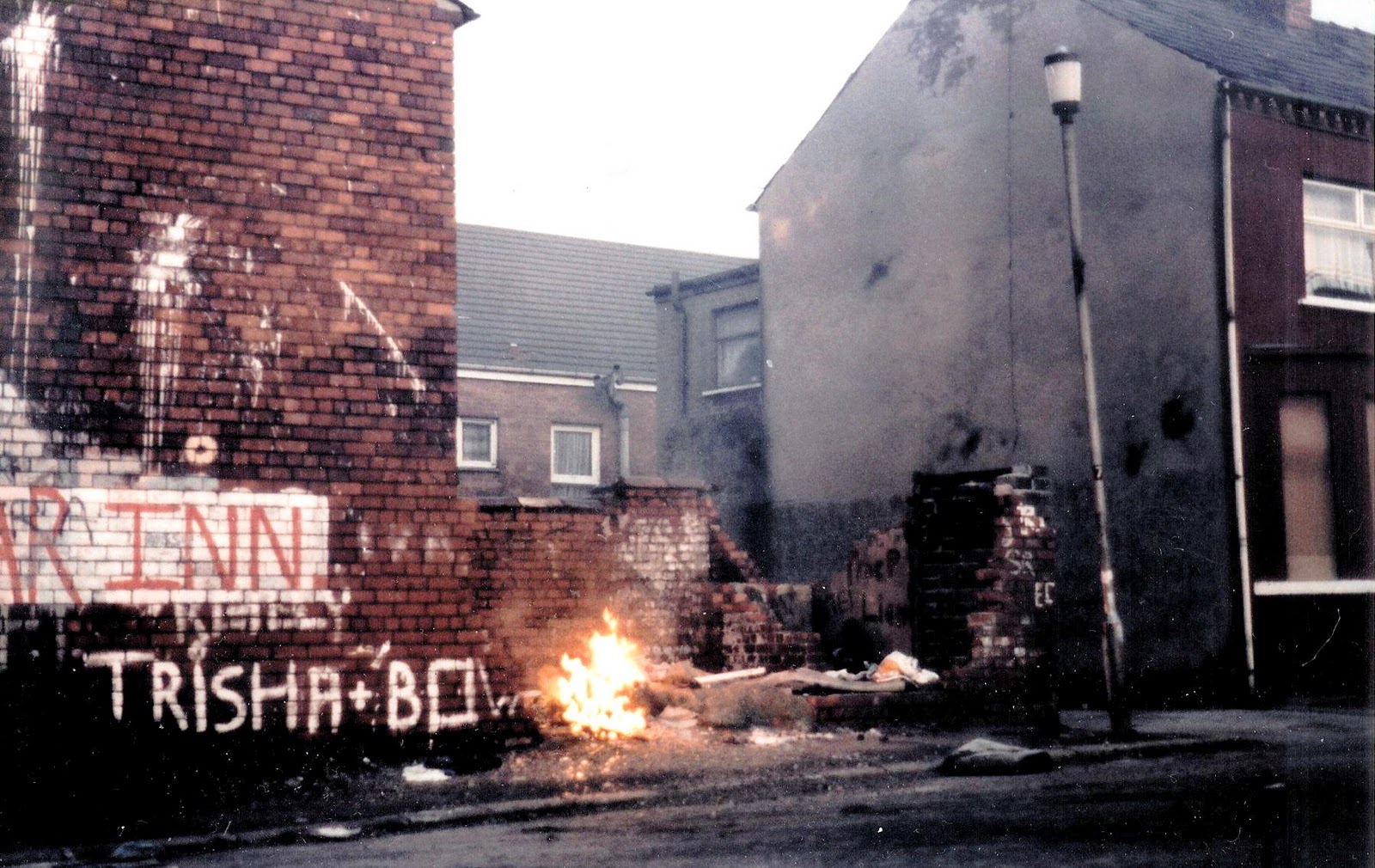
A fire burns in an abandoned lot in the Catholic Falls neighborhood of Belfast.
Life went on in Belfast despite the "Troubles" - adults went to work and children went to school - but the whole place appeared to an American as a war zone.  

The advantage of going there with a group - and under the cover of academic freedom - was we had terrific access to players on all sides.  We were welcomed by militant and political groups on both sides of the divide.  They knew Americans had a role to play in this drama, and they were eager to make a case for their positions to the visiting Yanks.

Yes, we did encounter some men who I'm sure were active in the infamous IRA.  They had such a cold, detached stare in their eyes that only someone who had been fighting an unwinnable war for decades could possess.  But the Loyalist paramilitary groups, the Ulster Defence Association (UDA) and Ulster Defence Regiment (UDR), were just as frightening.  The IRA seemed to relish the give and take of political debate while the UDA and UDR just wanted to state their position and get you the hell out of there.

I was appreciative of the opportunity to meet representatives of all sides and try to come to my own conclusions (which wasn't easy).

Although there's much work to be done, I am pleased to report that life in Belfast and Northern Ireland is much more peaceful, stable and prosperous twenty-five years later.

Senator George Mitchell - appointed as special envoy to Northern Ireland by President Clinton - was incredibly patient and effective in getting the sides together to reach some peace accords (the Good Friday Agreement) in 1998 and convince them to continue their fight in Parliament rather than in the streets.

Well it was a powerful day and there were black crows in the road
And I kept my strong opinions to my chest
I suppose I should have told them that I was on fire for you
When the bus burst into flames outside some place, 'The Poet's Rest'

And now you say that you've got to go
Well if you must you must
I suppose that you need the sleep of the just
 -from Sleep of the Just by Elvis Costello 

All photos in this post are ©1986, 2011 V.W. Cleary.  All rights reserved.

Monday, October 3, 2011

The Best Is Yet to Come

The great Tony Bennett.

There are some entertainers who die far too soon - like Amy Winehouse, Kurt Cobain and the other famous members of the "27" Club -  and they are eternally frozen in time in our memory at that early age.  You can't imagine a 75 year old Buddy Holly or 68 year old Jim Morrison still alive and playing in Vegas.  We will always remember them at the young ages they were - still filled with possibility and promise.

Other entertainers seem to have successful careers for decades and decades, quietly under the radar.  Finally, they reach a point where they're revered and celebrated for their longevity and staying power.  We all love to see someone like Betty White - who was never a huge star - stick around for decades and decades of consistently good work.  She's a pro.  Last year she was officially crowned the Grand Dame of American comedy.

Anthony Benedetto - you probably know him as Tony Bennett - was born in 1926 and grew up in New York in the shadow of Frank Sinatra.  Ten years Sinatra's junior, Bennett was humble, quiet and smooth to Sinatra's bravado, flash and edge.  Bennett has had a successful recording and performing career for sixty years that only slowed with the advent of Rock 'n Roll in the 1960's and 1970's.

Bennett remained talented and skilled as a vocalist during that time, but was considered by the Baby Boomers as too "Vegas" and "old school."  He was someone your parents listened to, not you.

Then something happened in the 1990's.  Bennett kept quietly working and recording, continuing to hone and master his understated vocal skills.  He transitioned from "has-been" to "elder statesman."

He made a landmark TV appearance on MTV's "Unplugged" program in 1994 and suddenly Tony Bennett was cool again.  Younger musicians like Bono, Elvis Costello and k.d. lang  - appreciative of his talent, longevity and graciousness - loved him and wanted to sing with him.

I had my brush with Mr. Bennett in the early 1990's - just as he started his comeback.  Only he had never really left, we just hadn't been paying attention.

In my job as a Flight Attendant, I had many occasions to serve entertainers and famous people who were passengers on my flights, especially when I worked flights in and out of Los Angeles and San Francisco.

So it wasn't a total shock on a Saturday afternoon at LAX, as I waited to board a flight to San Francisco from the front galley of a BAE-146 (a small, British-built commuter plane that was so mechanically unreliable that crews joked that "BAE" stood for "Bring Another Engine"), that at the end of the boarding process my only passenger in First Class - sitting by himself at the window seat in the front row - was Tony Bennett himself.

I welcomed him aboard, asked him if I could hang up his coat (he declined) or get him anything to drink.  His sole request was a cup of hot water with a slice of lemon (a common drink request for a singer).

Mr. Bennett was not very tall - I would guess 5' 5" - but he was barrel-chested and solid.  He moved slowly, yet gracefully.  Many entertainers I've met have a restlessness about them - they are always moving around and fidgeting on the plane as if it's impossible for them to just be still.  Not Mr. Bennett.  He just exuded stillness and calm.  He seemed incredibly comfortable just being himself (a surprisingly rare trait for entertainers).

I asked him why he was flying up to San Francisco that day and he simply said he was performing that night.  He was polite, but not chatty.  Friendly, but formal.  He was immaculately dressed in a dark, tailored suit with a pink shirt and silk tie perfectly tied in a Windsor knot.

Central Park (1998) by Anthony Benedetto; Smithsonian American Art Museum.
Immediately after we took off, he removed a small 8" x 11" sketch pad and some drawing pencils from a small leather case he kept at his side.  He looked out the window and gazed at the passing clouds and started to draw with one of the pencils.

I knew he had some standing as an accomplished painter - at least an accomplished celebrity painter - by then.  He just sat and quietly sketched and sipped his warm lemon water for the entire 50 minute flight up to The City where he left his heart.

We landed at SFO and parked at the gate right on time.  Mr. Bennett closed up his sketch pad and placed it and his drawing pencils back in his small leather case.  He stood up, holding the case in one hand and walked towards me, his other hand outstretched to shake my hand and said, "Thank you."  Then he turned and quietly walked out the door and up the jetway, carrying only his leather drawing case.

Talk about cool!  Man, was he cool.  He looked like a zillion bucks on a Saturday afternoon in a way that said, "I love being Tony Bennett and I can roll right out of bed and look this good."

Tony Bennett has just released an album, Duets II, and at the young age of 85 years old he has his first ever #1 album on the Billboard charts.  The album features a duet with Mr. Bennett and Amy Winehouse.  It was Winehouse's last recording session.

I often tune to an artist's "channel" on Pandora while I'm writing about a musician and listen to their music.  Tony Bennett was the only living artist played on the Pandora "Tony Bennett" channel while I wrote this.  That's because Tony Bennett is the last living singer of his generation.  Like most great artists, he just makes it look so easy and effortless.  And if that were really true, there would be more like him.

I also try and look at a couple of YouTube clips before I write these posts.  Strangely, there aren't any good clips of Mr. Bennett singing his trademark song, I Left My Heart in San Francisco.  Overzealous intellectual property lawyers, would be my guess.

Which is a shame because he owns that song and new generations should be encouraged to discover and enjoy it.  It's still played at the "Put your corporate telecommunications company name here" Ballpark in San Francisco after the conclusion of every Giant's game.  For me, it never gets old.

But no night in San Francisco - even when the fog rolls in - is ever as cool as Mr. Tony Bennett.

I'll leave you with Tony Bennett and Diana Krall (also a huge favorite of mine) on their duet of The Best Is Yet to Come: