Showing posts with label Dublin. Show all posts

Monday, September 26, 2011

The Statues of Dublin

Dublin native Oscar Wilde, author of The Importance of Being Ernest and The Picture of Dorian Gray, lounges comfortably in Merrion Square.  This is my personal favorite of the statues of Dublin.  Dubliners have nicknamed it "The Fag on the Crag," "The Quare in the Square," and "The Queer with the Leer."

Ireland is an island of only five million people, and in the past hundred years has produced four winners of the Nobel Prize for Literature - only two less than the United States.

These two women on Liffey Street are known as "The Hags with the Bags."

There's a tourist trap castle in the Southwest - Blarney Castle - that draws millions of tourists a year to pay a few quid to lie upside down and kiss an old rock that has been kissed by millions of other people - all in the name of acquiring the Irish "gift of gab."

Irish literary legend James Joyce still stands just off O'Connell Street in Dublin, but if you're meeting a Dubliner by "The Prick with the Stick," you're in the right place.
The Irish love to talk and many of them love to write.  Ireland produces acclaimed writers and playwrights at a pace that far outweighs its population.  Words and language are a vital part of Irish life.

Sweet Molly Malone, subject of a famous Irish folk song, now plies her trade selling "cockles and mussels" at the bottom of Grafton Street.  Dubliners have dubbed her "The Flirt in the Skirt," "The Trollop with the Scallop," "The Bitch with the Hitch," "The Dolly With the Trolley", and my personal favorite: "The Tart with the Cart."
Dublin, Ireland is a city of statues.  You can't turn a corner in the City Centre without encountering another statue or piece of sculpture commemorating something or someone.  And as quickly as the Irish government can plan and erect these statues, the Irish people can come up with witty and hilarious nicknames for them.  Many of these statues have multiple nicknames that are known by every Dubliner. 

The statue of Anna Livia (from Joyce's Finnegan's Wake) in its original location on O'Connell Street in Dublin's City Centre.  Dubliners nicknamed her "The Floozie in the Jacuzzi."

Dublin went a little overboard for the new Millennium, erecting new statues and landmarks around the city.  A digital clock counting off the time until the new Millennium was placed in the dark waters of the Liffey, the river that runs through the centre of Dublin.  Dubliners were ready and doled out several nicknames for the odd clock that lay in the murky Liffey.

Dubliners quickly dubbed the Millennial Clock "The Clock in the Dock" and "The Time in the Slime."
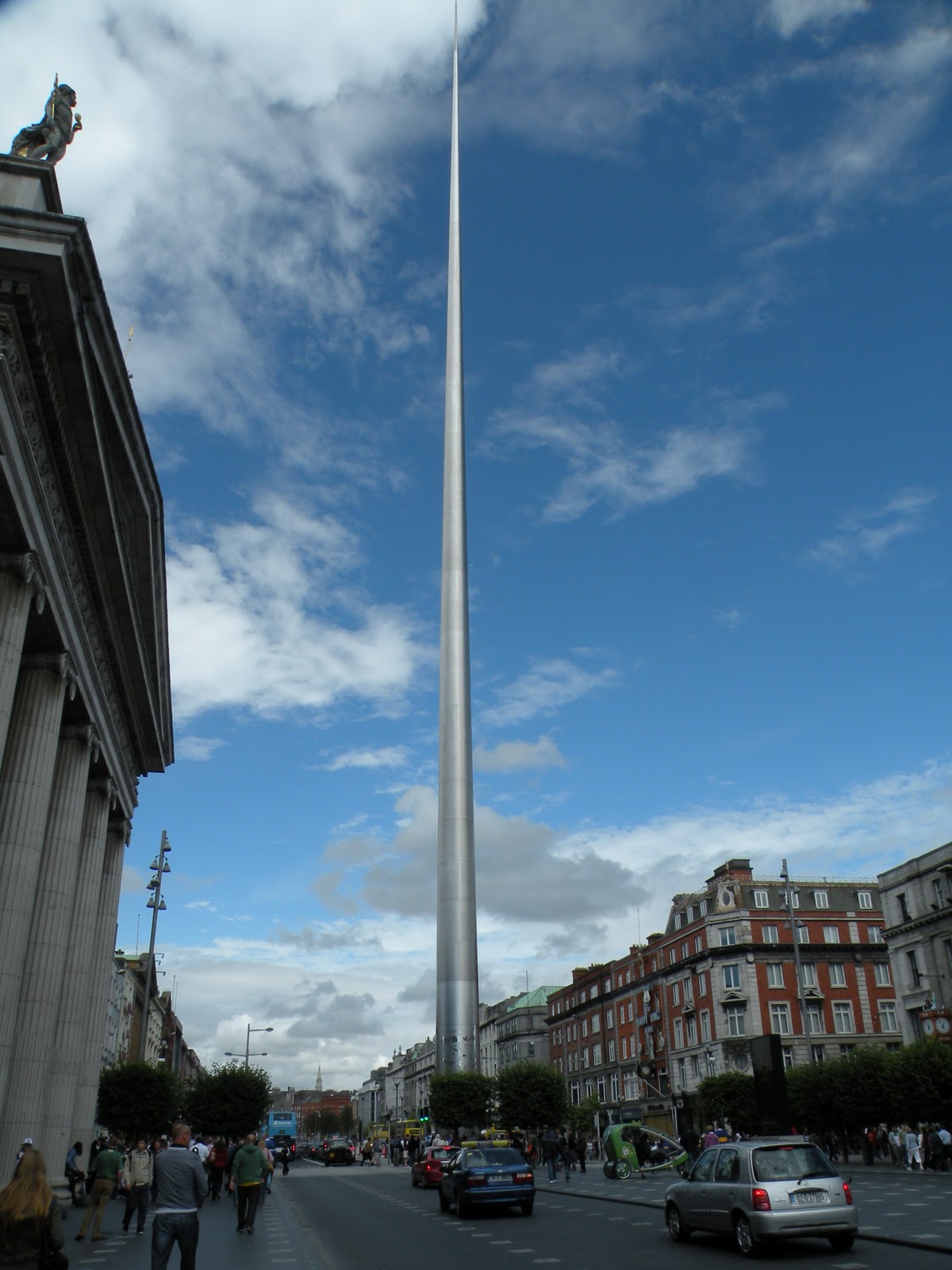
The largest piece for the Millennium celebration was a few years late to the party.  The "Spire of Dublin" is now located in the space vacated by "The Floozie in the Jacuzzi" in the middle of O'Connell Street - the main street that runs through the centre of Dublin.  Before the cement was dry, Dubliners had a series of nicknames ready including "The Binge Syringe," "The Stiletto in the Ghetto," "The Nail in the Pale," "The Pin in the Bin," "The Erection in the Intersection," and "The Rod to God."

"
The World's largest sculpture is officially known as The Spire of Dublin, but many locals refer to it as "The Stiffy by the Liffey."

I have no clue which notable Irishman or what landmark event will next be commemorated by a statue or monument in some open space or square in Dublin.  But I'm quite confident that in a pub in Dublin, around a few pints of Guinness stout,  several Dubliners will brainstorm up multiple nicknames before it passes the planning commission.  And I'll drink to that.  Sláinte.

Monday, September 12, 2011

Walking the Long Miles Home

The last 19A bus of the night leaves Dublin's City Centre, north towards Glasnevin.
Oh, the last bus has gone
Or maybe I'm wrong
It just doesn't exist
And the words that flew
Between me and you
I must be crossed off your list
So I'm walking the long miles home
I don't mind losing you
In fact I feel better each step of the way
In the dark I rehearse all the right things to say
I'll be home, I'll be sober by break of day
Walking the long miles home 

- The opening lyrics of Richard Thompson's song Walking the Long Miles Home


In the Fall of 1986, I lived with an Irish family and studied for a semester at the National Institute for Higher Education (now known as Dublin City University) in Glasnevin, a suburb just 5 kilometres north of Dublin's City Centre (downtown).   

The cost of car ownership was prohibitively expensive in Dublin 25 years ago; I didn't know a single student at my college who owned or drove a car.  A gallon (3.8 liters) of petrol  alone would set you back 3 quid (Irish slang for their "pound," which was then equivalent to approx. $1.35 U.S.) or $4 U.S.  The cars the Irish drove were tiny by American standards, and even those rarely had automatic transmissions.

Fortunately, Dublin had an excellent public transportation system.  All of us at the college had a student bus pass, and I used mine frequently to get back and forth between my house and Dublin's City Centre (An Lar in Irish).  The shock for an American accustomed to late night, or even all night, public transportation was that the last bus of the night left Dublin's City Centre at 11:30 p.m, even on Saturday nights.  Not very late for young people having a night on the town.

I attended several concerts that drifted past 11:00 p.m., and you could sense the audience getting restless, apprehensive about missing the last bus home.  A stagehand would sheepishly walk out to the performer about 11:05 p.m., whisper in their ear, and then the performer would say to the crowd, "I understand you all need to catch the last bus of the night, so this will be the final song of the evening."

Taxi service did exist in Dublin, although they tended to cluster around large hotels that served Americans and business people, rather than just cruising around the streets, like in New York.  They were prohibitively expensive.  A short 2-3 mile ride from the City Centre out to a house in the suburbs could easily cost $15-20 U.S.  Quite dear for college students on a budget.  I believe I only got in a taxi 2-3 times during my entire four months in Dublin.

So if you were out on the town with your mates, coming out of a movie, concert or a play, let's say, and you wanted to extend the evening by heading to a pub for a pint, and then over to Beshoff's chipper for some steaming, hot chips; around 11:15 p.m. you would have to make a decision: were you going to catch the last bus home or stay in town and walk home?  Was the craic - Irish for fun and good conversation - with your evening's companions in the the next two or three hours worth the 45 minute walk home in the dark at the end of the evening?  That was the question.

Dissolve to thirteen years later.  Richard Thompson, one of my favorite singer-songwriters, released a terrific album, entitled Mock Tudor, that included several great songs about what it was like to grow up in the suburbs of the United Kingdom.  During the 1950's for him, but it hadn't changed much since then.  Imagine my surprise to hear one of the songs entitled Walking the Long Miles Home.  It was about the experience I just described above.  Was your date or your companions worth missing the last bus and being forced to walk home?  It described an experience that any youngster growing up in the suburbs of Dublin or the U.K. had experienced.  I loved the song, of course, but I appreciated it so much more than the average American because I had lived it during my time in Dublin.

I did stay in Dublin past the last bus with my friends, or with a date, on several occasions, and then walked the long miles back home.  I must have possessed good judgement because I remember those walks home as some of the best and most revelatory times of my stay in Ireland.  I really got to know so many of my friends from college during those jaunts.  Dublin was so elegant and peaceful during those early morning rambles.  Sure, it occasionally rained.  But it was usually a "soft" rain, as the Irish would say, a mere light mist; and if that bothered you, well, then you were just in the wrong country.

Every time I hear the song Walking the Long Miles Home on the radio, or it comes up on my iPod, I am immediately conveyed back in time to those late nights and early mornings in Dublin, walking home with my friends.  And knowing there's a song out there that can transport you back to such a memorable moment and place can be a magical thing.  That's what great songwriters do.  Don't ever question Richard Thompson's credentials as a musical magician.

I'd love to order another pint and stay around and chat, but it's 11:20.  Gotta' run for my bus.  Ah, but the craic was grand.

If you are unfamiliar with the work of the brilliant singer-songwriter Richard Thompson, you may want to listen to a few of his songs below.

His version of the traditional folk song, Oops!...I Did It Again:


The sing-a-long audience favorite Tear-Stained Letter:


And if you've made it this far, here's one of my favorites, Vincent Black Lightning 1952, a chilling ballad that he has sung every time I have seen him live - and which never fails to silence the audience and send a shiver down your spine.  Also, his only song which contains my name in the title.

Sunday, August 14, 2011

Céad Mile Fáilte

Arriving in Dublin from the West, looking East to the Irish Sea.
As the power pulled back on the four massive engines of the Aer Lingus Boeing 747, I was awakened from my overnight nap by the sensation of the aircraft making its descent. Flying over the Atlantic at such velocity, I realized the six hour flight would have been a harrowing 6 week journey by sea for my ancestors of 150 years ago.

Gazing out the window to the Emerald Island below, which indeed does glisten with forty shades of green, I couldn't help the overwhelming sensation that I had come home.

I am of Irish descent on both sides of my family.  My surname, Cleary, is descended from the Irish chleirich, meaning a clerk or cleric.

Although my maternal grandparents would eat corn beef and cabbage each St. Patrick's Day, regularly play old Irish folk music albums, and have cute little Irish tchotchkes around the house, with pictures of shamrocks and leprechauns, and featuring Irish quotes such as "you're never drunk as long as you can hold on to one blade of grass, and not fall off the face of the earth," they had never been to Ireland.

They were Irish-American, which meant they wore their Irishness with a sense of pride that would exceed that of anyone back in the old country.  Still, it was quite a shock to my mother and her sisters when my grandfather, who had never set foot on the auld sod, would start to recite ancient Gaelic prayers that my family had never heard pass his lips before upon his deathbed.

An Aer Lingus Boeing 747 arrives in Dublin.
As Irish as he truly was, as Irish as my paternal grandparents had been, with the Irish surnames Cleary and Morrissey, they were all still a couple of generations removed from the old country.  And to my knowledge, I was the first of my family to return to Ireland.

It wasn't until I boarded the plane in Boston seven hours before, that it really started to hit me that Dublin would be my home for the next four months.

The gigantic plane with the distinctive, green Aer Lingus livery - the huge white shamrock on the tail - was my first reminder that I was indeed on my way to Ireland.  The flight attendants chatting with their Irish accents as they walked through the cabin, the Irish pilot making an announcement detailing our route and the expected weather in Dublin upon our arrival (the possibility of "some good sunny spells"), the safety instructions in the seat pocket written in English and Gaelic.  It was all unmistakably...Irish.

It seemed like such a short time had passed since my mother informed me that my younger brother was going to study abroad for his Junior year in Seville, Spain.  She wondered if there was some place in Europe where I would like to study for a semester.  Ireland.  Only Ireland.

The airborne behemoth continued its descent, lumbering left and right, straightening out, and then finally touched down at Dublin Airport.  Ireland.  I was now on Irish soil.

The flight attendant started her arrival announcement in Gaelic with "Céad Mile Fáilte," Gaelic, or Irish, for "a hundred thousand welcomes," a traditional Irish greeting.

Departing the aircraft and walking down a labyrinth of hallways until I came to two lines of passengers, I stopped, and then patiently stood in the shorter line to the left, labeled for Americans only,  and proceeded up to the Irish immigration officer.  I took my blue American passport from my pocket and placed it upon the counter.

"Good morning. Where are you from?," the officer asked, grabbing the document, not looking up.

"California.  Los Angeles, California," I replied.

"And what brings you to Ireland, Mr. Cleary?," he continued to query, now running my passport through a scanner next to the keyboard of his computer.

"I'm a student.  I'll be studying this semester at N.I.H.E. in Glasnevin."

N.I.H.E. in Dublin.  No expense spared on the sign.
He looked up for the first time, comparing the picture in the passport to my face.  I stared back.  Satisfied, he turned his attention back to my passport,  and reached for an instrument next to his right hand, which he raised and then brought down on my passport with a loud "thunk," placing the arrival stamp of the Dublin Airport on the first page.  He closed the passport and slid it across the counter.

"Welcome home, lad."

I was officially in Ireland.  Another subversive Yank successfully smuggled into the country.

In moments I would meet the Irish host family who had been prearranged to provide room and board during my stay in Dublin.  They would be MY Irish family, MY Dublin family, by the time I would return to America in four months.  They still are twenty-five years later.
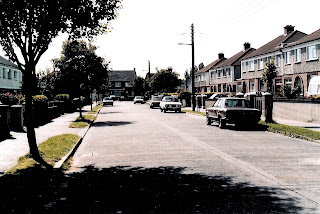
Pinewood Crescent in Glasnevin, Dublin.
(Pinewood Crescent (LEFT) , Glasnevin North, Dublin 11.  Number 24, a "semi-detached" home - what Americans would call a duplex -  halfway down the street on the right, was my Dublin home for the Fall of 1986.)  

I stepped out of the Terminal and into the "soft" Irish morning, as they'd say in Dublin, exhausted, or "knackered," from the overnight flight; unaware that I was arriving as a young Yank, and would depart four months later as a lifelong Dubliner.

Yes, some tea and soda bread would be lovely.  Both.  That's grand.

Céad Mile Fáilte.  A hundred thousand welcomes.